
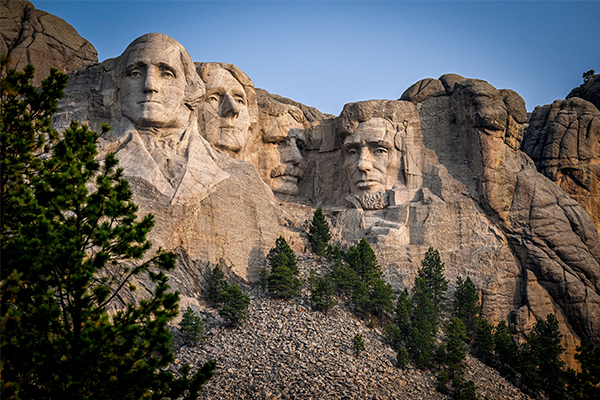
In the heart of South Dakota, among the pine trees and granite rocks of the Black Hills, stands one of America’s most recognisable monuments: Mount Rushmore. It immortalises the images of four presidents in stone and has become a symbol that embodies history, art and the context of the times. When you look up at the four carved faces, you get a sense of physical and temporal scale.
How the idea to carve a mountain came about
The idea was born in the 1920s, when historian Doan Robinson was looking for a way to attract tourists to South Dakota. He dreamed of creating a grand work that would make travellers from all corners of the country look at its history in a new way.
Initially, Robinson wanted to depict the heroes of the Wild West – Lewis and Clark, Blake and other pioneers. But the invited sculptor Gutzon Borglum, a man with ambitions no less than the granite cliffs, suggested a different path. He decided to create a monument of national significance – to show four figures representing the birth, growth, development and preservation of the United States. Thus, Mount Rushmore – a nameless rock once named after lawyer Charles Rushmore – became the future site where history would be carved in stone.
Why these four presidents were chosen
When creating the monument, Gutzon Borglum wanted to capture the very idea of America in granite. He considered dozens of historical figures, but understood that the images chosen had to be recognisable and have deep meaning for every citizen.
Each president, according to his plan, was to symbolise a certain stage in the country’s development. Thus was born the idea of bringing together on one mountain four personalities who, taken together, tell the story of the nation.
Each of the four portraits has a symbolic meaning:
- George Washington – the founder of the nation, the man with whom it all began.
- Thomas Jefferson – the author of the Declaration of Independence, a thinker who embodied the idea of freedom.
- Theodore Roosevelt – a symbol of industrial progress and reform, a defender of nature.
- Abraham Lincoln – the president who managed to preserve the country during the Civil War and free the slaves.
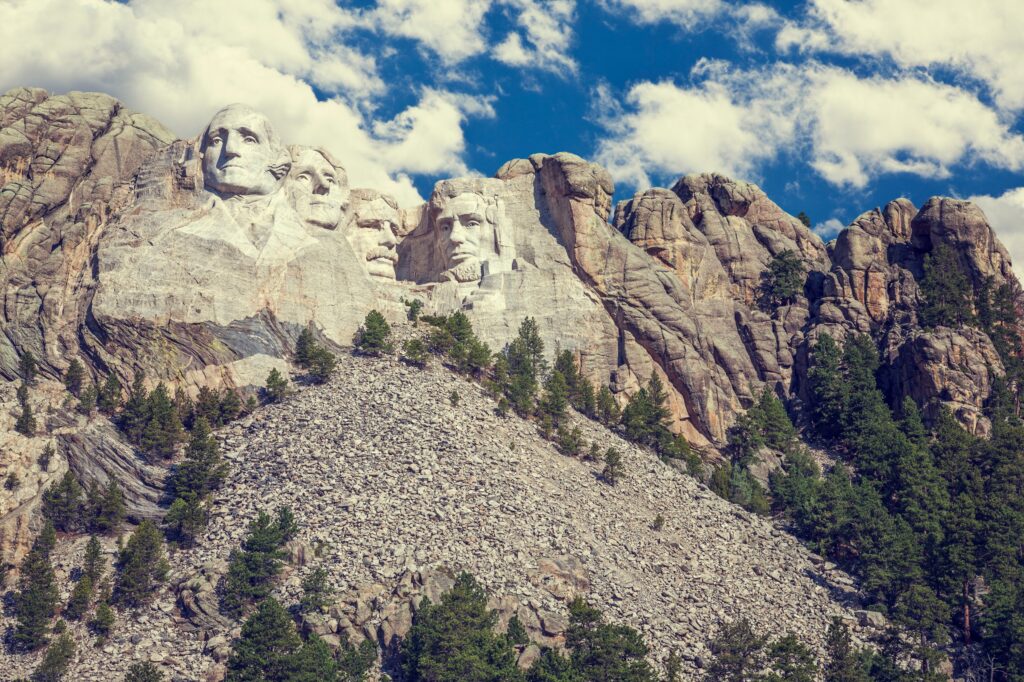
These four represent different eras, but they are united by one thread – their belief in the development and stability of the state. Their selection was carefully considered, as each figure carries historical and moral significance. The monument has become a kind of ‘stone chronicle’ of the American dream, where the past, present and future converge in a single gaze directed towards the horizon.
Construction: granite, dust and courage
Work began in 1927 and continued for 14 years. The project was gigantic in scale and spirit. Borglum personally supervised the construction, setting up workshops on the slopes and developing unique methods of carving granite.
More than 400 workers – drillers, blasters, and rock climbers – toiled on the rock. They climbed to a height of about 1,700 metres above sea level, working under the scorching sun and in cold winds. Dynamite and pneumatic hammers were used to extract the rock, and the precision work was done by hand with chisels and hammers.
A total of about 450,000 tonnes of rock was removed from the mountain. Despite the danger, no one was killed. By 1941, the faces of the presidents had taken on their final appearance, although the project was originally conceived on a larger scale, with images of torsos and symbolic scenes.
Mount Rushmore today: an open-air museum
Today, the national memorial is managed by the US National Park Service and welcomes over 2 million visitors annually. There are viewing platforms for tourists, an Avenue of Flags with the state flags of all the states, and the Borglum Museum, where you can see the original tools and models.
In the evening, a solemn lighting ceremony is held, when the faces of the presidents are illuminated by soft spotlights and the US national anthem is played. This moment makes a strong impression even on those who have seen the monument dozens of times.
Mount Rushmore has become a symbol of the national idea, a reminder of leadership, perseverance and the ideals of democracy. But at the same time, it is also a reason for discussion about the price of progress, historical memory and whose history is immortalised in stone.
Interesting facts
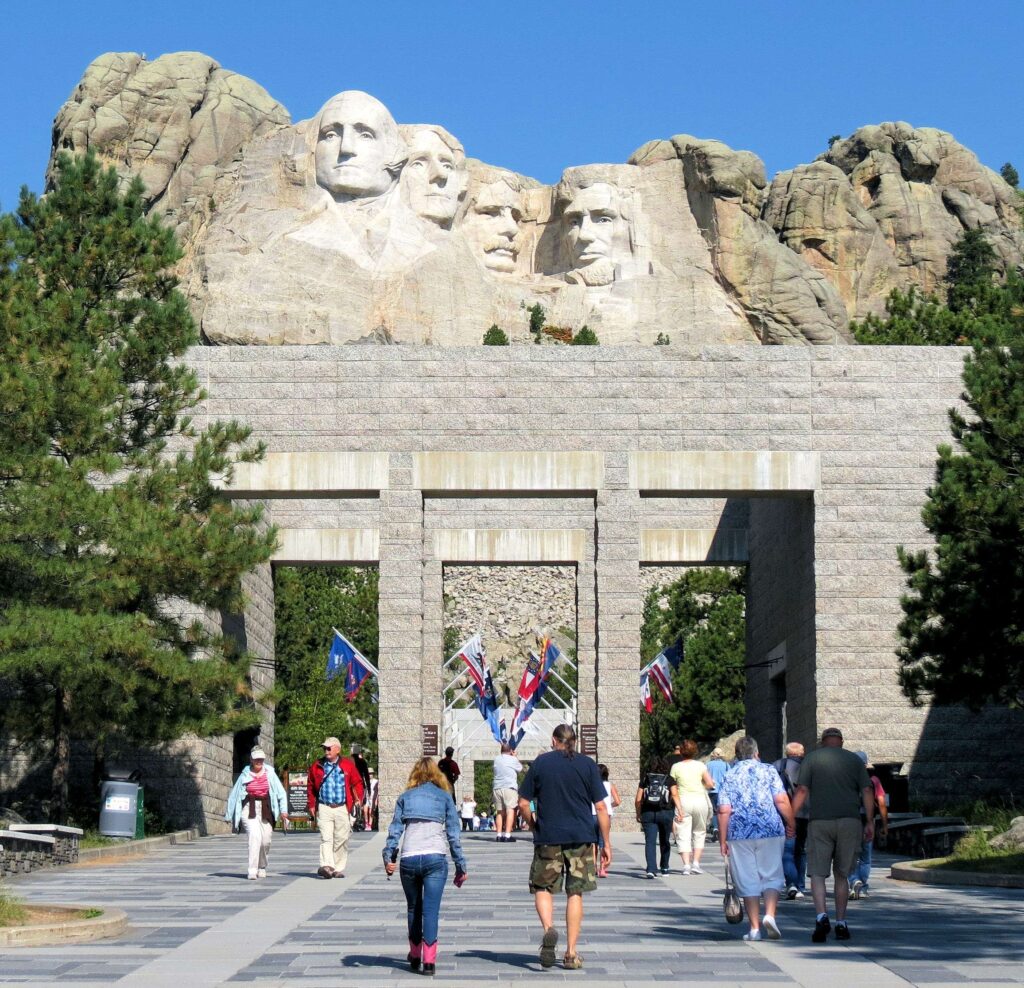
Many travellers, seeing the huge faces of the presidents, do not even realise how many mysteries and technical subtleties this granite wall hides.Historians still argue about how realistic Gatson Borglum’s project was in terms of its scale, because at the time construction began, there was simply no previous experience of this kind.
Before heading to the monument, it is worth knowing a few interesting details that will help you see it from a different angle:
- There is a secret room in the rock, conceived by Borglum as the ‘Hall of Chronicles’ — a place to store documents, symbols and messages for future generations.
- The mountain is composed of granite that is over 1.2 billion years old, making it particularly durable and resistant to erosion.
- Several locations were initially considered for the construction, but Rushmore was chosen for its light surface and rock stability, which was ideal for carving.
- The project cost less than a million dollars to complete, which even at the time was considered a surprisingly modest budget for such a grand undertaking.
Since 1991, the monument has been featured on the South Dakota state coin and is often used in federal emblems and US tourism logos. Each of these facts reveals a new facet of this legendary monument. When you stand at the foot of the mountain, you realise how incredible this engineering feat was for the 1930s.
Visiting and routes
Mount Rushmore is located near the town of Keystone, about a 40-minute drive from Rapid City. The road passes through picturesque mountain passes and national parks where you can see bison and deer.
The site offers parking, cafés, gift shops, interactive exhibits, and a visitor centre. Many travellers combine their trip with visits to Badlands National Park and Crazy Horse Memorial, which together form a rich historical and cultural itinerary through South Dakota.
Over the decades of its existence, the monument has not lost its relevance. It has survived wars, changing eras and views, but has remained a point of attraction where one can reflect on how history is created and rewritten. A symbol of power and freedom, both inspiring and controversial, Mount Rushmore continues to be part of the American narrative in textbooks and in the minds of millions of people.